
Search is changing faster than most website owners can keep up with. Google’s AI Overviews, ChatGPT, Perplexity, and Gemini are now answering questions directly — often without sending a single click to the websites that provided the information. For anyone who runs a blog or business site, this raises an urgent question: if AI is answering the question before a user ever visits a website, how do you make sure your brand is the one being cited?
That’s the problem Generative Engine Optimization (GEO) is built to solve. This guide breaks down what GEO is, how it’s different from traditional SEO, and what you can start doing today to stay visible as AI search grows.
Table of Contents
- Key Terms to Know
- What Is Generative Engine Optimization (GEO)?
- Why GEO Matters Now: The Zero-Click Search Shift
- GEO vs. SEO vs. AEO: What’s the Difference?
- How to Optimize Your Content for AI Search
- Tools for Tracking AI Search Visibility
- Is Traditional SEO Dead?
- Final Thoughts
- Sources
Key Terms to Know
Before diving in, here are the core terms you’ll need to understand this topic:
- Generative Engine Optimization (GEO): The practice of optimizing content so AI systems like ChatGPT, Gemini, and Google’s AI Overviews are more likely to reference, cite, or recommend it in their generated answers.
- Zero-click search: A search where the user gets their answer directly on the results page (through an AI summary, featured snippet, or knowledge panel) and never clicks through to a website.
- AI Overviews: Google’s AI-generated summaries that appear at the top of search results, answering the query before any organic links are shown.
- Answer Engine Optimization (AEO): The practice of structuring content so it directly and clearly answers specific questions, making it easier for both search engines and AI systems to extract.
- Citation (in AI search): When an AI system references a specific website or brand as the source of information in its generated response — the AI-era equivalent of a backlink.
- Large Language Model (LLM): The underlying AI technology (like GPT or Gemini) that powers chatbots and AI search summaries by predicting and generating human-like text.
- E-E-A-T: Google’s framework for evaluating content quality — Experience, Expertise, Authoritativeness, and Trustworthiness.
What Is Generative Engine Optimization (GEO)?
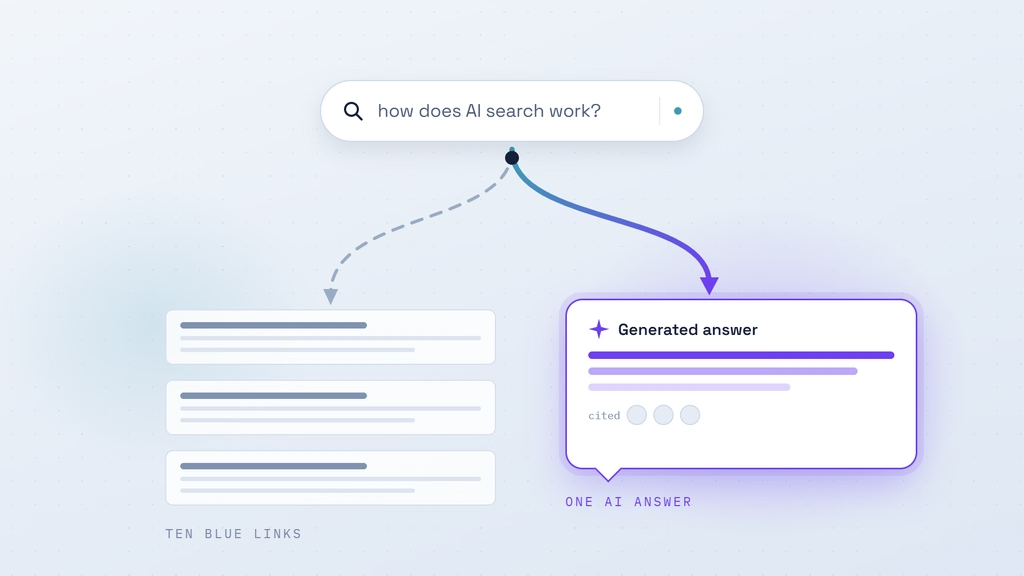
Generative Engine Optimization is the emerging discipline of making content more likely to be understood, trusted, and cited by AI systems that generate answers instead of just listing links. Unlike traditional search engines, generative engines don’t work on a position-based ranking system — there’s no “#1 spot” to fight for. Instead, visibility depends on whether an AI system chooses to mention, quote, or recommend a brand at all.
This is a meaningful shift for anyone who has spent years optimizing for Google’s traditional “10 blue links.” If you’ve read our earlier piece on structured data and schema markup, you already know how important machine-readable content has always been for search visibility — GEO takes that same principle and applies it to a new generation of AI-driven search tools.
Why GEO Matters Now: The Zero-Click Search Shift
The urgency behind GEO comes down to one trend: fewer searches are ending in a click.
Data from Similarweb and other industry trackers shows informational queries — the “what is,” “how does,” and definitional searches most blogs are built around — now resolve without a click in a large majority of cases as AI summaries answer them directly. Google’s AI Overviews alone have expanded from covering roughly 12% of search queries in mid-2024 to an estimated 58% by early 2026, and individual websites have reported significant drops in click-through rate when an AI Overview appears above their listing.
The upside is that not all traffic loss is equal. Research from Similarweb has found that visitors who do click through from AI-generated results tend to convert at meaningfully higher rates than traditional organic visitors, because by the time someone clicks, the AI has already done some of the filtering work for them. This mirrors a pattern we discussed in our earlier article on DeepSeek’s impact on the AI landscape — AI tools are changing user behavior faster than most content strategies can adapt.
The takeaway: getting clicked is no longer the only measure of success. Getting cited — appearing by name inside an AI-generated answer — has become a visibility goal in its own right.
GEO vs. SEO vs. AEO: What’s the Difference?
These three terms are often used interchangeably, but they solve different problems:
| Discipline | Core Question | What It Optimizes For |
|---|---|---|
| SEO | Can this page rank? | Traditional search engine result pages |
| AEO | Can this content answer a question directly? | Featured snippets, voice search, direct-answer boxes |
| GEO | Can an AI system trust and cite this brand? | AI Overviews, ChatGPT, Gemini, Perplexity responses |
Importantly, these disciplines are complementary rather than competing. Strong technical SEO — fast load times, clean site structure, mobile responsiveness — still helps AI systems crawl and understand your content in the first place. GEO simply adds a new layer on top: earning the AI’s trust enough to be quoted by name.
One notable wrinkle: research cited by GEO analysts suggests the overlap between top-ranking Google pages and the sources AI systems choose to cite has fallen sharply — from around 70% to under 20% in some studies. In other words, ranking well on Google no longer guarantees your content will be the one an AI chooses to reference. This is a similar disconnect to what we found comparing Gemini, Copilot, ChatGPT, and DeepSeek head-to-head last year — each AI system has its own preferences for which sources it trusts.
How to Optimize Your Content for AI Search
While the GEO playbook is still developing, a few practices are consistently recommended by SEO researchers and AI search analysts:
1. Lead with a direct answer. Structure articles so the first paragraph or two directly answers the core question, before going into detail. AI systems tend to extract from content that gets to the point quickly.
2. Use clear structure and headings. Logical headers (like the ones in this article), bullet points, and tables make it easier for AI systems to parse and extract specific facts — much like the mobile-first indexing principles we covered in our guide to optimizing for mobile-first indexing.
3. Add original data or perspective. Thin, generic content that just repeats what’s already online is unlikely to be cited. AI systems are more likely to reference sources that add something new — original research, a unique angle, or clearly stated expertise.
4. Build topical authority. Publishing consistently on a subject, and linking related articles together, signals to both search engines and AI crawlers that a site has real depth on a topic. This is exactly why we consistently link back to related articles across Modern Tech Tips — it builds a body of connected, authoritative content over time.
5. Keep technical SEO fundamentals in place. Backlinks, fast load times, and structured data still matter. AI systems rely on live web search and crawled data to generate answers, so a technically weak site can be invisible to both traditional search and AI search alike.
6. Maintain consistent brand information. Keep your name, descriptions, and key facts consistent across your site, social profiles, and any directories. Inconsistent information makes it harder for an AI system to confidently cite a brand.
Tools for Tracking AI Search Visibility
As GEO matures, a small ecosystem of tracking tools has emerged to help site owners measure whether they’re actually appearing in AI-generated answers. These tools generally work by running a batch of relevant search queries against AI platforms like ChatGPT, Gemini, and Perplexity, then reporting whether and how a brand is mentioned.
You don’t need expensive software to get a basic read on your own visibility. A simple manual test: pick 10–20 questions your audience is likely to ask, run them through ChatGPT, Perplexity, and Gemini, and note whether your site is mentioned, how it’s described, and which competitors are cited instead.
Is Traditional SEO Dead?
No — but its job has changed. Some analysts have compared it to the moment featured snippets and knowledge panels first appeared: a disruption, not a death sentence. Backlinks, technical health, and quality content all remain foundational, because AI search engines still lean on the same crawled web data and live search results that power traditional SEO. Ranking well continues to feed into GEO performance, even if it no longer guarantees an AI citation on its own.
For a small blog like Modern Tech Tips, the practical response isn’t to abandon SEO practices covered in our earlier posts on SEO and PPC integration or using SEO tools for tracking — it’s to build GEO practices on top of them.
Final Thoughts
GEO isn’t a replacement for SEO — it’s the next layer built on top of it. As AI Overviews, ChatGPT, and other generative engines take on a bigger share of how people find information, brands that focus on clear structure, original insight, and consistent authority will be best positioned to earn citations, even as raw click-through traffic declines industry-wide.
The shift is still early, which means there’s a real opportunity for smaller, focused sites to build AI search visibility before the space gets crowded.
Sources
- Similarweb – Zero-Click Marketing: What the 2026 Data Means
- Digital Applied – 60% Zero-Click Searches: The 2026 SEO Crisis Strategy
- ALM Corp – AI Overviews and Zero-Click Searches: Adapting Your SEO Strategy for 2026
- LLMrefs – Generative Engine Optimization (GEO): The 2026 Guide to AI Search Visibility
- SEO.com – Rising Generative Engine Optimization (GEO) Trends for 2026
- Erlin.ai – Generative Engine Optimization Trends for 2026
- SEO Inc. – AI and SEO in 2026: Zero-Click Search, AI Overviews & GEO
Related reading on Modern Tech Tips:
- The Role of Structured Data and Schema Markup in Improving Search Visibility
- How to Optimize Your Website for Mobile-First Indexing
- The Benefits of Using SEO Tools for Website Optimization and Tracking
- 6 Ways to Integrate SEO and PPC Marketing Strategies
- Comparison Between Gemini, Copilot, ChatGPT and DeepSeek
- What Is DeepSeek?



Leave a Reply